


Sherlock Jr. y cómo el cine cambia vidas

Actualizado: 14 abr

“Sherlock Jr. and How Cinema Changes Lives”
This entry is part of the 12th Annual Buster Keaton Blogathon!, hosted by Silentology. Silentology is an ode to silent cinema; it was truly my great discovery of last year. I highly recommend diving into the waters of that wonderful blog.

After having directed 20 short films (if we count Rough House, which he co-directed with Fatty Arbuckle), Keaton launched himself into making his first feature film: 3 Ages is like a parody of Griffith’s Intolerance and it consists of three stories that respond to a central concept, you could say 3 short films; his second film, Our Hospitality, is more narrative, it deals with a single central plot, and there Buster takes the time to properly develop the story and the characters over an hour and 20 minutes of film; in his third feature (and the one that concerns us today), Sherlock Jr., he once again sets itself apart from the first two: there is only one story, yes, but you can tell that Keaton returns in a certain way to his roots, to what we saw in his early shorts: gags, gags, and more gags (!) per minute... In fact, it feels like a long short film (?).
The three first Buster Keaton feature films
The story is simple: a projectionist who is in love with a girl, she loves him and he does not know it; two things motivate him: winning her over and becoming a detective.

The gags that make up this 45-minute film are very funny: the dollar bill gag (“describe it” hahaha), when the price of the chocolates changes, the ring with the tiny little stone... The pool sequence, in which Keaton builds with tremendous SUSPENSE: the explosive billiard ball, the poison, and the seat that triggers the axe blow, all elements that fulfill their function of generating suspense and, at the same time, give you so much to dig into in terms of gags.
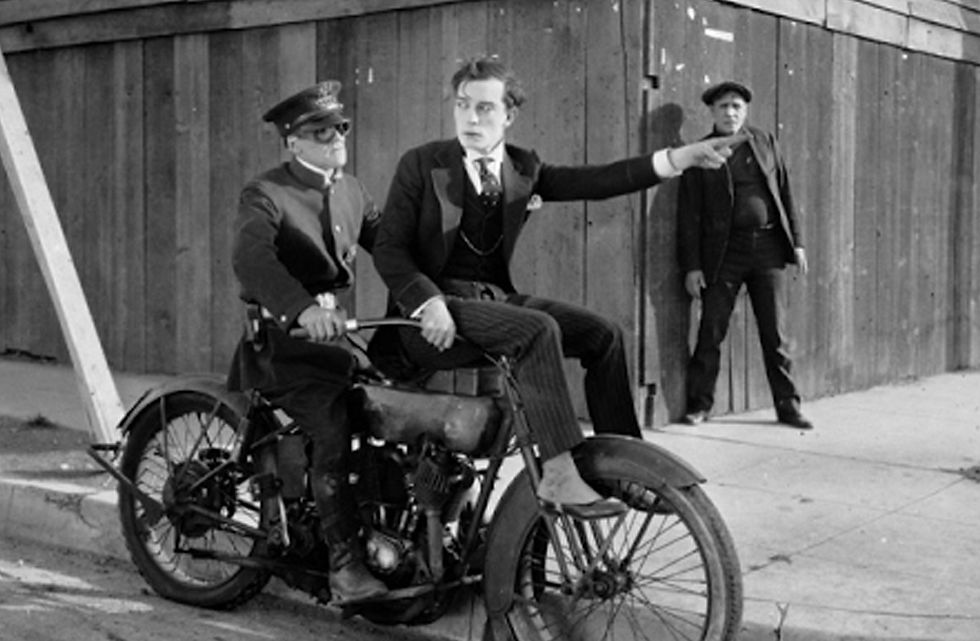
All the objects in the film get used, they are not there just for the gag, but also contribute to the construction of the universe and are in service of the narrative. The ring he gives the girl has a tiny little stone, and he pulls out a magnifying glass so she can see it better (he has a magnifying glass because he wants to be a detective). He also always carries his “how to be a detective” manual, which determines the next action Buster’s character will take.

On the other hand, it has a very dreamy cinema-within-cinema section that drives me crazy, because it is accompanied by some insane special effects for that time period (and for now too, because it is all analog!!). When Buster falls asleep and comes out as his astral projection, it is the most beautiful thing in the world. And when he enters the big screen, good lord... he breaks the fourth wall within the four walls (!)... also the level of millimetric synchronization he handles when the film he entered changes scenes and he is still there... absolute madness.

Coming back to this whole cinema-within-cinema idea, I love the way Buster Keaton represents cinema; the simple dreamer projectionist projects himself precisely into the movies as someone brave, sly, and audacious (which is the character of Sherlock Jr), it is beautiful... The final scene is one of the most beautiful I have ever seen in my entire life (no joking) and one that captivated me the most. That is cinema: from it / with it we learn, we project, we dream. Cinema shows the projectionist character that, in reality, in order to get what he wanted most, he did not have to do much, he did not have to be the hero of the movies: his longing was already there, right beside him. Cinema helped him overcome his shyness and the character’s arc closes in a perfect way... it is worth pointing out that Keaton’s character is useless, and the one who ends up resolving the conflict is her, who always loved him anyway, just as useless and dreamy as he is.

I fervently love this gem from the 1920s by Buster Keaton, which very intelligently does a work of metafiction, with oniric moments, and one gag funnier than the next. It had been a long time since I had seen a film I liked this much... Cinema, or films, are something that has always been present in my life, I always projected myself onto many of them, making me watch them and live them intensely, and Keaton in Sherlock Jr. understands that feeling perfectly and captures it in a captivating way in this film... Cinema, beyond entertaining us, reflects us, functions as a mirror of our life and our experiences, and many times helps us think about ourselves.
Sherlock Jr y Cómo el Cine Cambia Vidas - En Español
Después de haber dirigido 20 cortometrajes (si contamos Rough House, que co-dirigió con Fatty Arbuckle), Keaton se lanzó a hacer su primer film largo: 3 Ages es como una parodia de Intolerancia de Griffith y son tres historias que responden a un concepto central, 3 cortometrajes podría decirse; su segunda película, Our Hospitality, es más narrativa, se trata de una sola trama central, ahí Buster se toma el tiempo de desarrollar bien la historia y los personajes en hora y 20 de película; en su tercer largo (y el que nos compete hoy a) Sherlock Jr., se vuelve a diferenciar de las dos primeras: hay una sola historia, sí, pero se nota que Keaton vuelve en cierto modo a sus raíces, a lo que veíamos en sus primeros cortos: gags, gags y más gags (!) por minuto... De hecho, se siente como un corto largo (?).
La historia es simple: un proyectorista que está enamorado de una chica, ella lo ama y él no lo sabe; dos cosas lo motivan: conquistarla y convertirse en detective. Los chistes que componen esta película de 45 minutos son muy graciosos: el gag del billete (“descríbamelo” jajaja), cuando cambia el precio de los bombones, el anillo con la piedrita diminuta... La secuencia del pool, en la que Keaton construye con un SUSPENSE tremendo: la bola de billar explosiva, el veneno y el asiento que activa el hachazo, todos elementos que cumplen su función de generar suspenso y, a su vez, dan muchísima tela para cortar en cuanto a gags.
Todos los objetos de la película se usan, no son solo para el chiste, sino que hacen a la construcción del universo y están en función de la narrativa. El anillo que le regala a la chica tiene la piedra diminuta, y él saca una lupa para que la vea mejor (tiene una lupa porque quiere ser detective). También lleva siempre su manual de “cómo ser detective”, que determina la acción siguiente que tomará el personaje de Buster.
Por otro lado, tiene un apartado cine dentro del cine muy dreamy que me vuelve loco, porque está acompañado de unos efectos especiales demenciales para esa época (y ahora también, porque es todo analógico!!). Cuando Buster se duerme y sale como su proyección astral, es lo más bello del mundo. Y cuando ingresa a la pantalla grande, mamita querida... rompe la cuarta pared dentro de las cuatro paredes ()... también el nivel de sincronización milimétrica que maneja cuando la película a la que entró cambia de escena y él sigue ahí... una locura.
Volviendo a esta cuestión del cine dentro del cine, me encanta cómo representa al cine Buster Keaton; el simple proyectorista soñador se proyecta justamente en las películas como alguien valiente, pillo y audaz —que es el personaje de Sherlock Jr.—, es bellísimo... La última escena es una de las más hermosas que vi en mi vida y que más me cautivó. Eso es el cine: de él/con él aprendemos, proyectamos, soñamos. El cine le muestra al personaje del proyectorista que, en realidad, para conseguir lo que más quería no tenía que hacer mucho, no tenía que ser el héroe de las películas: su anhelo ya estaba ahí, a su lado. El cine lo ayudó a superar su timidez y se cierra el arco del personaje de una manera perfecta... cabe destacar que el personaje de Keaton es un inútil, y la que termina resolviendo el conflicto es ella, que siempre lo quiso igual, así de inútil y soñador.
Amo fervientemente esta joya de los años 20 de Buster Keaton, que muy inteligentemente hace un trabajo de metaficción, con momentos oníricos, y un gag más gracioso que el otro. Hace mucho no veía una película que me haya gustado tanto... El cine o las películas son algo que siempre estuvo presente en mi vida, yo siempre me proyecté en varias de ellas, haciendo que las vea y las viva intensamente, y Keaton en Sherlock Jr. entiende a la perfección esa sensación y la plasma de una manera cautivadora en este film... El cine, más allá de entretenernos, nos refleja, funciona como un espejo de nuestra vida y nuestras experiencias y muchas veces ayuda a pensarnos a nosotros mismos.


Comentarios